Hardware Overview
Important: Read Before Use!
ESD Sensitivity
The mosaic-G5 P3 GNSS receiver is sensitive to ESD. Use a proper grounding system to make sure that the working surface and the components are at the same electric potential.
ESD Precaution
As recommended by the manufacturer, we highly recommend that users take the necessary precautions to avoid damaging their module. For example, users can utilize the iFixit Anti-Static Wrist Strap.

Active Antenna
Never inject an external DC voltage into the GNSS antenna, as it may damage the mosaic-G5 P3 GNSS receiver. For instance, when using a splitter to distribute the antenna signal to several GNSS receivers, make sure that no more than one output of the splitter passes DC. Use DC-blocks otherwise.
Introduction


-
SparkPNT GNSS Flex modules are plug-in boards featuring different GNSS receivers. They are designed to be easily swapped for repairs and pin-compatible for upgrades. The boards have two 2x10-pin, 2mm pitch female headers connecting to carrier boards. For the mosaic-G5 P3 GNSS receiver, these pins will break out the USB and UART (x2) interfaces, along with the PPS signals, event triggers, and GPIO using a standardized pinout. Additionally, these pins break out the two UART interfaces of the IM19 IMU.
This SparkPNT GNSS Flex module features the Septentrio mosaic-G5 P3, a 60% smaller and 40% lower power consumption variant of the mosaic-X5 GNSS receiver, making it ideal for drone and IoT applications. The receiver supports the GPS (USA), GLONASS (Russia), Beidou (China), Galileo (Europe), and QZSS (Japan) GNSS constellations, including regional systems (i.e. SBAS). With its Real-Time Kinematics (RTK) capabilities, the GNSS receiver can achieve a horizontal accuracy of 6mm (~0.25in), vertical accuracy of 1cm (~0.4in), PPS timing resolution of 1.4ns (1.4 billionths of a second), and event trigger accuracy below 3ns. It also features Septentrio's unique AIM+ technology for interference mitigation and anti-spoofing, ensuring best-in-class reliability and scalable position accuracy. Users can control and configure the GNSS receiver through a command-line interface (CLI) using the Septentrio Binary Format (SBF), NMEA, and RTCM v3.x protocols. Otherwise, users can also configure the GNSS receiver with Septentrio's RxTools software application.
Tilt Compensation
The IM19 attitude module from Feyman (FMI) fuses MEMS IMU sensor data and GNSS RTK positioning to deliver high-precision attitude compensated measurements, with roll and pitch accurate to within 0.05 degrees. This kind of superb accuracy has widespread uses in industrial applications such as tilt RTK surveys (where RTK poles need not be held straight vertical as the IM19 can calculate a virtual digital level at any tilt angle), agriculture machine automation, and dead reckoning.
When configured, fed with the mosaic-G5 P3 Pulse-Per-Second signal and NMEA GGA, RMC, and GST messages; once calibrated, the IM19 will output proprietary NMEA messages containing the compensated position and roll, pitch and yaw. By default, the mosaic-G5 P3
COM4TXis linked to the IM19UART2RXto carry the required NMEA messages. However, this can be changed via jumper links on the Flex Module, if necessary.
Product Comparison: GNSS Products
Below is a simple comparison table between our mosaic-X5 and mosaic-G5 GNSS products; and Septentrio's development and evaluation kits:
mosaic-X5 Development Kit
|
mosaic-go X5 Evaluation Kit
|
mosaic-go G5 Evaluation Kit
|
mosaic-X5 GNSS Breakout
|
RTK mosaic-X5
|
SparkPNT RTK Facet mosaic
|
mosaic-G5 P3 GNSS Breakout
|
mosaic-X5 Flex Module
|
mosaic-X5 +IM19 Flex Module
|
mosaic-G5 P3 Flex Module + IM19 IMU (optional) 
|
|
|---|---|---|---|---|---|---|---|---|---|---|
| GNSS Antenna | Dual |
1 - X5 2 - H |
2 - G5 P3* 2 - G5 T* 2 - G5 P3H |
1 | 1 | Integrated | 1 | 1* | 1* | 1 |
| USB Connector | micro-B | micro-B | Type-C | Type-C | Type-C | Type-C | Type-C | N/A* | N/A* | N/A* |
| Ethernet | Yes | No | No | No | Yes | No | No | 2x10 Header* | No | No |
| WiFi | No | No | No | No | Yes | Yes | No | No | No | No |
| COM Ports | 4 | 2 | 2 | 4 |
1 - mosaic-X5 1 - ESP32 |
1 - mosaic-X5 1 - ESP32 |
2 | 4 |
2 - mosaic-X5 2 - IM19 IMU |
2 - mosaic-G5 2 - IM19 IMU* |
| µSD Card Slot | Yes | Yes | Yes* | Yes | Yes | Yes | No | 2x10 Header* | 2x10 Header* | No |
| Reset/Log Buttons | Yes | No* | No* | Yes | Yes | Yes | No | No | No | No |
| Logic-Level |
1.8V 3.3V |
3.3V | 3.3V | 3.3V |
3.3V 5V |
3.3V | 3.3V | 3.3V | 3.3V | 3.3V |
| PPS Signal | Header Pin | 6-Pin JST Connector | Header Pin | SMA Connector | Screw Terminal | No | Header Pin | 2x10 Header* | 2x10 Header* | 2x10 Header* |
| Enclosure Material | N/A | Metal | Metal | N/A | Aluminum | Plastic | N/A | N/A | N/A | N/A |
| Dimensions | N/A | 71.0 x 59.0 x 12.0mm ± 1mm | 74.0 x 44.0 x 11.4mm | 70.9 x 50.8 x 8mm |
180.6 x 101.8 x 41mm Enclosure Only |
43.2 x 43.2 x 8mm | 44.0 x 34.0 x 10.4mm | 44.0 x 34.0 x 10.4mm | 44.0 x 34.0 x 8.5mm | |
| Weight | N/A | 58g ± 1g | 50g | 22.60g |
415.15g Enclosure Only |
11.15g | 14.00g | 15.25g |
- IMU: 9.20g + IMU: 10.95g |
mosaic-go Evaluation Kits
- For the mosaic-X5 and mosaic-H, the reset pin is exposed on 4-pin JST connector and the log pin is connected to the latch pin of the SD card slot.
- For the mosaic-G5 P3/T/H, the reset pin is exposed on a header pin. There is no log pin, data logging must be enabled through a command set. Logging to internal disk (
DSK1) is only for debugging purposes, feature is prone to data gaps during operation.
mosaic-G5 P3 GNSS Flex Modules
SparkPNT GNSS Flex modules are modular, plug-in boards that utilize a carrier board to access the pins of the GNSS Flex headers.
- The GNSS only variant of the SparkPNT GNSS Flex module that only includes the mosaic-G5 P3 GNSS receiver; without populating the IM19 IMU.
- The IMU variant of the SparkPNT GNSS Flex module includes the IM19 IMU for RTK tilt-compensation applications with the mosaic-G5 P3.
Design Files
-
Design Files
- Schematic
- KiCad Files
- STEP File
- Board Dimensions:
- 1.75" x 1.25" (44.45mm x 31.75mm)
-
Manipulate 3D Model
Controls Mouse Touchscreen Zoom Scroll Wheel 2-Finger Pinch Rotate Left-Click & Drag 1-Finger Drag Move/Translate Right-Click & Drag 2-Finger Drag 
Dimensions of the mosaic-G5 P3 GNSS breakout board. Need more measurements?
For more information about the board's dimensions, users can download the KiCad files for this board. These files can be opened in KiCad and additional measurements can be made with the measuring tool.
KiCad - Free Download!
KiCad is free, open-source CAD program for electronics. Click on the button below to download their software. (*Users can find out more information about KiCad from their website.)
 Measuring Tool
This video demonstrates how to utilize the dimensions tool in KiCad, to include additional measurements:

Board Layout
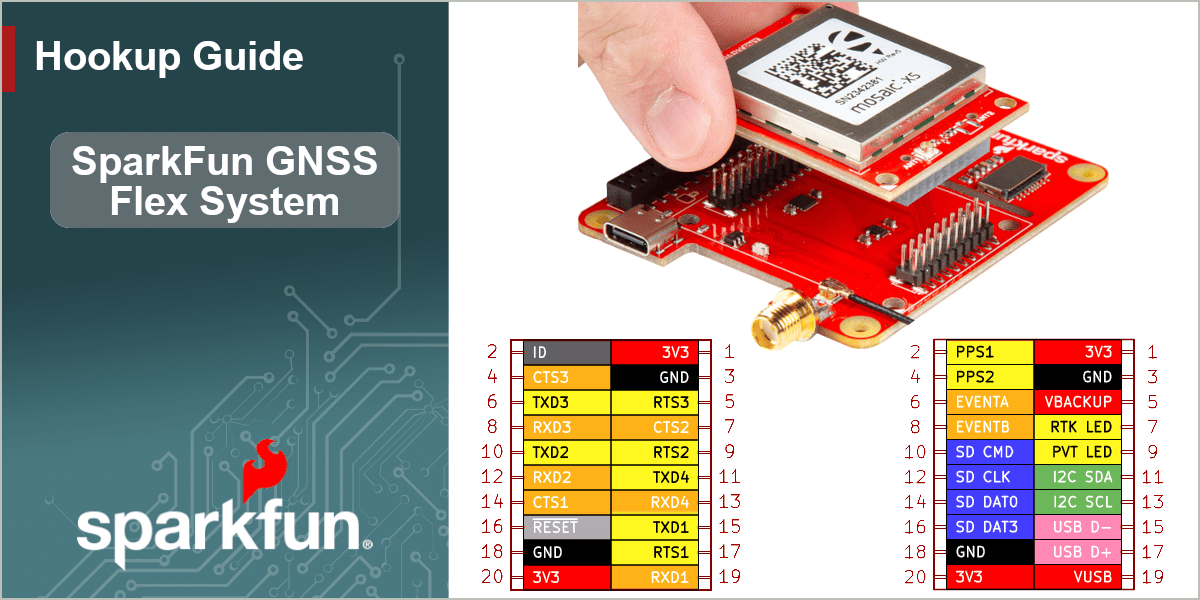
The GNSS Flex system is designed around two 2x10-pin, 2mm pitch headers used to mate the two types of boards. A standardized pin layout, keeps the ecosystem pin-compatible for upgrades and allows boards to be easily swapped for repairs. Depending on the capabilities of the GNSS receiver, these pins will breakout the USB, UART (x4), I2C, and SD card interfaces along with any PPS or event signals of the GNSS receiver.
The mosaic-G5 P3 Flex module has the following features:

Layout of the major components on the mosaic-G5 P3 GNSS Flex module.
-
- mosaic-G5 P3 GNSS Receiver
- The Septentrio mosaic-G5 P3 GNSS receiver
-
- GNSS Flex Headers
- Two sets of 2x10 pin, 2mm pitch female headers for connecting a GNSS Flex module to carrier boards
-
- IM19 IMU (optional)
- An optional Feyman IM19 attitude module to provide tilt compensation in surveying applications
-
L1/L2/L5/L6/L-BandU.FL Connector- An U.FL connector for attaching an external GNSS antenna
mosaic-G5 P3
The centerpiece of the mosaic-G5 P3 GNSS Flex module, is the mosaic-G5 P3 GNSS receiver from Septentrio. Their mosaic-G5 P3 modules are low-power, multi-band, multi-constellation GNSS receivers capable of delivering centimeter-level precision in a small form factor without compromising on performance. They provide strong positioning reliability in challenging environments and are tailored for applications such as delivery or light show drones. It also features Septentrio's unique AIM+ technology for interference mitigation and anti-spoofing, which ensures their best-in-class reliability and scalable position accuracy.


The mosaic-G5 P3 GNSS receiver on the mosaic-G5 P3 GNSS Flex module.
Features:
- Operating Voltage: 3.135 - 3.465V
- GNSS Support
- GPS:
L1C/A,L1C,L2C,L2PY,L5 - GLONASS:
L1CA,L2CA,L2P,L3 CDMA - Beidou:
B1I,B1C,B2a,B2b,B2I,B3I - Galileo:
E1,E5a,E5b,E6 - QZSS:
L1C/A,L1 C/B,L2C,L5,L6
- GPS:
- Time to Fix
- Cold Start: < 35s
- Warm: < 10s
- Reacquisition: 1s
-
Position Accuracy
Correction Horizontal Vertical RTK 0.6cm (±0.5ppm)
~0.25"1cm (±1ppm)
~.4"DGNSS 40cm
~1.3'70cm
~2.3'Standalone 1.2m
~4'1.9m
~6.2'
- Update Rate: 20Hz
- Latency: < 10ms
- Event Accuracy: < 3ns
- Interfaces:
- UART (x2)
- USB device (2.0, HS)
- GPIO user programmable (x2)
- Event markers (x2)
- Configurable PPS out (x2)
- Protocols:
- Septentrio Binary Format (SBF)
- NMEA 0183, v2.3, v3.03, V4.0
- RTCM v3.x (MSM included)
- Antenna Specifications
- Preamplification Range: 15-50dB
- Bias Voltage: 3.0 - 5.5V
- 789 Hardware Channels
- Operating Temperature: -40 - 85°C
- Package Size: 16.4mm x 22.8mm x 2.4mm
- Weight: 2.2g
Tip
The capabilities of each receiver is defined by a the optional features that are enabled. The capabilities of the receiver depend on a combination of the hardware model and version, the firmware version, and the set of permissions enabled for the optional features. Permissions are further explained in Section 1.17 of the firmware manual. The command getReceiverCapabilities will list the receiver's capabilities. Otherwise, using RxControl (go to Help > Receiver Interface > Permitted Capabilities).
Power Consumption
The power consumption of the mosaic-G5 P3 GNSS receiver depends on the GNSS signals enabled and the positioning mode. The table below, lists the average power consumption for common configurations. The current listed, is based on a supply voltage of 3.3V.
| GNSS Signals | Power (mW) | Current (mA) |
|---|---|---|
| GPS/GLONASS L1/L2 | 440 | 133 |
| All signals from all GNSS constellations | 570 | 173 |
| All signals from all GNSS constellations +L-band | 670 | 203 |
Source: mosaic-G5 P3 Hardware Manual
Frequency Bands
The mosaic GNSS receivers are multi-band, multi-constellation GNSS receivers. Below, are charts illustrating the frequency bands utilized by all the global navigation satellite systems and the ones supported by the mosaic-G5 P3 GNSS receiver.

The frequency bands supported by the mosaic-G5 P3 GNSS receiver.
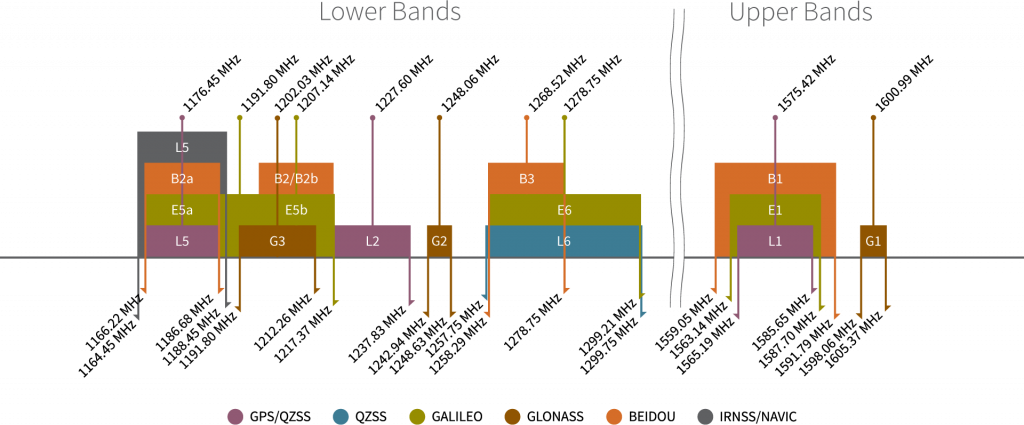
Frequency bands of the global navigation satellite systems. (Source: Tallysman)
Info
For a comparison of the frequency bands supported by the mosaic GNSS receivers, refer to section 3.1 of the hardware manual.
What are Frequency Bands?
A frequency band is a section of the electromagnetic spectrum, usually denoted by the range of its upper and lower limits. In the radio spectrum, these frequency bands are usually regulated by region, often through a government entity. This regulation prevents the interference of RF communication; and often includes major penalties for any interference with critical infrastructure systems and emergency services.

However, if the various GNSS constellations share similar frequency bands, then how do they avoid interfering with one another? Without going too far into detail, the image above illustrates the frequency bands of each system with a few characteristics specific to their signals. Wit these characteristics in mind, along with other factors, the chart can help users to visualize how multiple GNSS constellations might co-exist with each other.
For more information, users may find these articles of interest:
Position Accuracy
The accuracy of the position reported from the mosaic-G5 P3 GNSS receiver, can be improved based upon the correction method being employed. Currently, RTK corrections provide the highest level of accuracy; however, users should be aware of certain limitations of the system:
- RTK technique requires real-time correction data from a reference station or network of base stations.
- RTK corrections are signal specific (i.e. an RTK network might provide corrections on only
E5band notE5a).
- RTK corrections are signal specific (i.e. an RTK network might provide corrections on only
- The range of the base stations will vary based upon the RTK method being employed.
- The reliability of RTK corrections are inherently reduced in multipath environments. However, with Septentrio's multipath mitigation technology (APME+) on the mosaic-G5 P3, these errors are significantly reduced when compared to multipath mitigation techniques that modify the correlators in the tracking channels.
RTK Corrections
To understand how RTK works, users will need a more fundamental understanding of the signal error sources.
-

Real-Time Kinematics Explained
-

What is Correction Data?
-

GNSS Corrections Demystified
Tip
For the best performance, we highly recommend that users configure the GNSS receiver to utilize/provide RTK corrections with a compatible L1/L2/L5/L6 (All-band) GNSS antenna and utilize a low-loss cable.
IM19 IMU (Optional)
The other centerpiece of the GNSS Flex module is the IM19 attitude module from Feyman Inc., which fuses MEMS sensor and GNSS RTK positioning data to deliver high-precision attitude measurement, with roll and pitch accurate to within 0.05 degrees. This kind of superb accuracy has widespread uses in industrial applications such as tilt RTK surveys (where RTK poles need not be held straight vertical as the IM19 can calculate a virtual digital level at any tilt angle), agriculture machine automation, and dead reckoning.
When configured, fed with the Pulse-Per-Second signal and NMEA GGA, RMC, and GST messages from the GNSS receiver; once calibrated, the IM19 will output proprietary NMEA messages containing the compensated position and roll, pitch and yaw. By default, the mosaic-G5 P3 UART1 TX pin is linked to the IM19 UART2 RX pin to carry the required NMEA messages. However, this can be changed via jumpers on the Flex Module, if necessary.
-

Without the IM19 attitude module populated on the mosaic-G5 P3 GNSS Flex module. -

The IM19 attitude module populated on the mosaic-G5 P3 & IM19 GNSS Flex module.
Features:
- Power: 0.33W
- Data Rate: 100Hz
- IMU Accuracy: ≤1% * D(1σ, vehicle)
- Gyroscope
- ARW: 0.17°/√(h)
- Bias Stability: ±4.5°/h
- Range: ±1000°/s
- Accelerometer
- Speed RW: 0.04m/s/√(h)
- Bias Stability: ±0.3mg
- Range: ±16g
- Roll and Pitch: ≤0.02°(1σ)
- Heading/Yaw: ≤0.2°(1σ)
- Initialization: 1s (95%)
- Self-calibration Technique
Info
Please refer to the hookup guide linked below, for the operation of the IM19 attitude module in tilt-compensation applications:
Position Accuracy
When configured and calibrated, the IM19 attitude module can fuses its IMU sensor data with the received GNSS RTK positioning data to deliver a tilt compensated position.
| Tilt Angle | Accuracy |
|---|---|
| 0° - 30° | 1cm |
| <60° | 2cm |
mosaic-G5 P3 GNSS receiver
The accuracy of the position reported from the mosaic-G5 P3 GNSS receiver, can be improved based upon the correction method being employed. Currently, RTK corrections provide the highest level of accuracy. Its accuracy, displayed in the table below, should also be considered when implemented.
| Correction | Horizontal | Vertical |
|---|---|---|
| RTK | 0.6cm (±0.5ppm) ~0.25" |
1cm (±1ppm) ~.4" |
| DGNSS | 40cm ~1.3' |
70cm ~2.3' |
| Standalone | 1.2m ~4' |
1.9m ~6.2' |
GNSS Flex Headers
The GNSS Flex system is designed around two 2x10-pin, 2mm pitch headers used mate the two types of boards. A standardized pin layout, keeps the ecosystem pin-compatible for upgrades and allows boards to be easily swapped for repairs. For the mosaic-G5 P3 GNSS receiver, these pins will breakout the USB and UART (x2) interfaces along with two configurable PPS signals, two event signals, and two GPIO from the GNSS receiver.

The peripherals and I/O pins for the mosaic-G5 P3 GNSS receiver.
Below, are the features that are available from the mosaic-G5 P3 GNSS receiver.
Supported Interfaces:
- USB device (2.0, HS)
- 2x UART (LVTTL, up to 4 Mbps) (1)
- 2x GPIO user programmable
- 2x Event markers
- 2x Configurable PPS out (2)
- One of the two UART ports is piped to the IM19 module
- One of the two PPS signals is amplified and piped to the IM19 module

The peripherals and I/O pins for the IM19 attitude module.
Below, are the features that are available from the IM19 attitude module.
Supported Interfaces:
- UART (x2)
- Timing Signal (1)
- The timing signal is amplified from the mosaic-G5 P3 GNSS receiver
For most users, this will be the primary interface for the mosaic-G5 P3 GNSS receiver.

Info
When a GNSS receiver is initially connected to a computer, two virtual COM ports are emulated. These can be used as standard COM ports to communicate with the GNSS receiver.
The headers of the GNSS Flex system supports up to four UART ports. On this GNSS Flex module, these are connected to both the GNSS receiver and IM19 attitude module as shown in the table below.
| mosaic-G5 P3 | IM19 | Pins of GNSS Flex Headers |
|---|---|---|
UART1 |
---- | TXD1/RXD1 |
UART2 |
---- | TXD2/RXD2 |
| ---- | UART1 |
TXD3/RXD3 |
| ---- | UART2 - TX |
TXD4 |
| ---- | UART2 - RX |
TXD1 |

mosaic-G5 P3
The mosaic-G5 P3 GNSS receiver has two UART ports, which can be operated and configured separately.

- The
UART1andUART2ports of the mosaic-G5 P3 GNSS receiver are broken out to the headers of the GNSS Flex system, on pinsTXD1/RXD1andTXD2/RXD2/RTS2/CTS2respectively.- These can be used to interact with the GNSS receiver.
- Only the
UART2port supports flow control pins, which are disabled by default.
- By default, the
TXpin of theUART1port from the mosaic-G5 P3 GNSS receiver is also piped directly to theRXpin of the IM19 attitude module'sUART2port.
Default Configuration
By default, the UART ports are configured with the following settings:
- Baudrate: 115200bps
- Data Bits: 8
- Parity: No
- Stop Bits: 1
- Flow Control: None
- Protocols:
- Septentrio Binary Format (SBF)
- NMEA 0183, v2.3, v3.03, V4.0
- RTCM v3.x (MSM included)
| mosaic-G5 P3 | Pins of GNSS Flex Headers |
|---|---|
UART1 |
TXD1/RXD1 |
UART2 |
TXD2/RXD2 |
Tip
The COM port settings are set with the setCOMSettings command.
IM19
The IM19 attitude module has two UART ports, which operate separately; and are available from the headers pins of the GNSS Flex module. To provide an accurate tilt compensated position, the IM19 attitude module also requires a PPS signal that corresponds with the GNSS solutions.

- The
UART1port of the IM19 module is broken out to the headers of the GNSS Flex system, on pinsTXD3andRXD3.- These pins should be used to configure the IM19 module.
- The
UART2port of the IM19 module is used to receive RTK data from the GNSS receiver and output the tilt compensated data.RX- By default, receives data from theUART1port of the mosaic-G5 P3 GNSS receiver.TX- Outputs the tilt compensated data to theTXD4pin on the GNSS Flex headers, once IM19 module is configured and calibrated.
Default Configuration
By default, the UART ports are configured with the following settings:
- Baudrate: 115200bps
- Data Bits: 8
- Parity: No
- Stop Bits: 1
- Flow Control: None
- Protocols:
- AT Commands
- Proprietary Data Formats
- MEMS Raw data protocol
- GNSS Raw data protocol
- Binary NAVI positioning data protocol
| IM19 IMU | Pins of GNSS Flex Headers |
|---|---|
UART1 |
TXD3/RXD3 |
UART2 - TX |
TXD4 |
UART2 - RX |
TXD1 |
IM19 - Alternate Inputs
Users can modify the jumpers on the top of the GNSS Flex module, to utilize the TX pin from the UART2 port of the mosaic-G5 P3 GNSS receiver (i.e. TXD2 pin); or the RXD4 pin of the GNSS Flex headers instead.
From the mosaic-G5 P3, the PPS output signal's logic-level is 1.8V, but we have added a buffer to bumped up the signal's logic-level to 3.3V. The signal is then connected to the IM19 attitude module and PPS1 pin of the GNSS Flex module. In order to receive tilt-compensated data from the IM19 attitude module, this pin needs to be configured to provide a timing pulse at the same rate as the PVT solutions.
The 3.3V PPS signals can be access through the PPSx pins. The polarity, frequency, and pulse width of these signals can be configured with the setPPSParameters and setPPS2Parameters commands.

PPS signal output on the mosaic-G5 P3 GNSS Flex module.
Info
During module startup, these pins are first in high-Z mode for about 1s. Then they are driven low for another second before being driven to the intended user-selected level about 2s after powering up the module.
GPIO Pins
It is possible to use these pins as general-purpose I/O pins, but their maximum current limited to 8mA.
The mosaic-G5 P3 GNSS receiver features two general purpose I/O pins. These pins have a maximum output current of 16 mA and pulled-up by default. The function (level or LED status indicator) of these pins can be programmed with the setGPIO1Mode and setGPIO2Mode commands.

Along with its polarity, the output signal from these pins can be used to indicate one of the following status modes:
PVTLED: LED lights when a PVT solution is available.RTKLED: LED is off if the PVT is not in RTK mode, blinks in float RTK and is solid on in fixed RTK.-
TRACKLED: Tracked satellite indicator.LED Behavior
LED Behaviour Number of Satellites in Tracking Blinks fast and continuously
(10 times per second)0 Blinks once, then pauses 1-2 Blinks twice, then pauses 3-4 Blinks 3 times, then pauses 5-6 Blinks 4 times, then pauses 7-8 Blinks 5 times, then pauses 9+ -
DIFFCORRLED: Differential correction indicator.-
In rover PVT mode, this LED reports the number of satellites for which differential corrections have been provided in the last received differential correction message (RTCM or CMR).
LED Behavior
LED Behaviour Number of Satellites w/ Corrections LED Off No differential correction message received Blinks fast and continuously
(10 times per second)0 Blinks once, then pauses 1-2 Blinks twice, then pauses 3-4 Blinks 3 times, then pauses 5-6 Blinks 4 times, then pauses 7-8 Blinks 5 times, then pauses 9+ -
If the corrections are received from geostationary satellites over the L-band, the LED will be on for about 1 second, then blink fast twice.
-
Info
By default, these pins are configured in input mode with pull-up. Also, for about 2 seconds after powering or resetting the module, these pins are in input mode (pulled up) regardless of the user configuration stored in the boot configuration file.
The mosaic-G5 P3 GNSS receiver features two event input pins, which can be used to time tag external events with a time resolution of 3ns. Use the setEventParameters command to configure these pins. This is useful for waking the module up from its standby mode or for timing applications.

Tip
To properly detect event triggers:
- There must be a minimum of 5ms between two events on the same
EVENTxpin - There must be no more than 20 events in any interval of 100ms, on all the
EVENTxpins
U.FL Connector
Users will need to connect a compatible GNSS antenna to the L1/L2/L5/L6/L-Band U.FL connector. The type of antenna used with the mosaic-G5 P3 module affects the overall accuracy of the positions calculated by the GNSS receiver.
- Passive antennas are not recommended for the mosaic-G5 P3 GNSS receiver.
-
There is no need to inject an external DC voltage for the GNSS antenna. Power is already provided from the mosaic-G5 P3 module for the LNA of an active antenna.
Danger
Never inject an external DC voltage into the SMA connector for the GNSS antenna, as it may damage the mosaic-G5 P3 GNSS receiver. For instance, when using a splitter to distribute the antenna signal to several GNSS receivers, make sure that no more than one output of the splitter passes DC. Use DC-blocks otherwise.

The U.FL connector to attach an external GNSS antenna to the mosaic-G5 P3 GNSS Flex module.
Tip
For the best performance, we recommend users choose a compatible L1/L2/L5/L6/L-Band GNSS antenna and utilize a low-loss cable. Also, don't forget that GNSS signals are fairly weak and can't penetrate buildings or dense vegetation. The GNSS antenna should have an unobstructed view of the sky.
Info
This input is DC-biased and ESD-protected, so an active antenna can directly be connected without additional components. The VANT pin of the GNSS receiver provides external power for an active antenna. By default, this supply voltage is configured at 3.3V.
- An active antenna often features a LNA. This allows the GNSS receiver to boost the signal received by the GNSS receiver without degrading the SNR.
- The more bands an antenna supports, the greater the performance.
- Faster acquisition time.
- Access and support for the
L5GPS band can potentially mitigate multi-path errors. - Supporting more frequency bands, allows a GNSS receiver to be less susceptible to jamming and spoofing.
There are other key parameters related to an antenna that can make or break the signal reception from the satellites. These include, but are not limited to the operation frequency, gain, polarization, efficiency and overall loss.
Jumpers
There are five jumpers on the top of the board that can be used to easily modify the hardware connections on the board.
Never modified a jumper before?
Check out our Jumper Pads and PCB Traces tutorial for a quick introduction!
-

How to Work with Jumper Pads and PCB Traces

The jumpers on the mosaic-G5 P3 GNSS Flex module.
-
IMU GNSS Source- These three jumpers can be modified to change the source of the GNSS data for the IM19 attitude module.
RXD4- An alternate connection to the GNSS Flex header'sRXD4pin.TXD2- An alternate connection to theUART2TXpin of the mosaic-G5 P3 GNSS receiver.TXD1- The default connection to theUART1TXpin of the mosaic-G5 P3 GNSS receiver.

The signals from the mosaic-G5 P3 GNSS receiver to the VREF and REF jumpers on the board.
VREF- Controls the reference voltage for the internal TXCOIn- Voltage input for the internal TXCOOut- Reference voltage to power the internal TXCO
REF- Controls the reference clock signalIn- Reference clock signal inputOut- 10-MHz signal from the internal TCXO