 |
flux sdk
v01.05.00-3-gedf3296
Embedded C++ SDK
|
|
flux sdk
v01.05.00-3-gedf3296
Embedded C++ SDK
|
One of the key features of the Flux framework is the ability to automatically detect and load different I2C devices, while placing minimal requirements on the device driver developer.
The key goals set for devices and auto load in the Flux framework include:
To meet the goals for this subsystem, the Flux framework follows a Factory Pattern, using device "builders" to describe a device, and a "factory" to manage the registration, detection and instantiation of devices using these device specific builders.
The key classes to support this pattern are:
| Device Driver | The device specific driver, often implemented based on an existing Arduino Library |
| Device Builder | A device specific class that is automatically generated and used by the Framework to detect and instantiate a device |
| Device Factory | An overall singleton within the system that enables device registration at startup and device discovery, instantiation and initialization at runtime |
For device discovery and instantiation (not operation) the Device class in the Flux framework provides enough information for the Device Factory along with Device Builders to discover a device on the system and instantiate it.
To provide this introspection capability, while not requiring the actual instantiation of a device driver class, an "interface" of static methods are used for each class. As static methods, no actual device driver object is required to perform device - the static methods are just called.
The class hierarchy for the Device class is outlined in the following diagram:
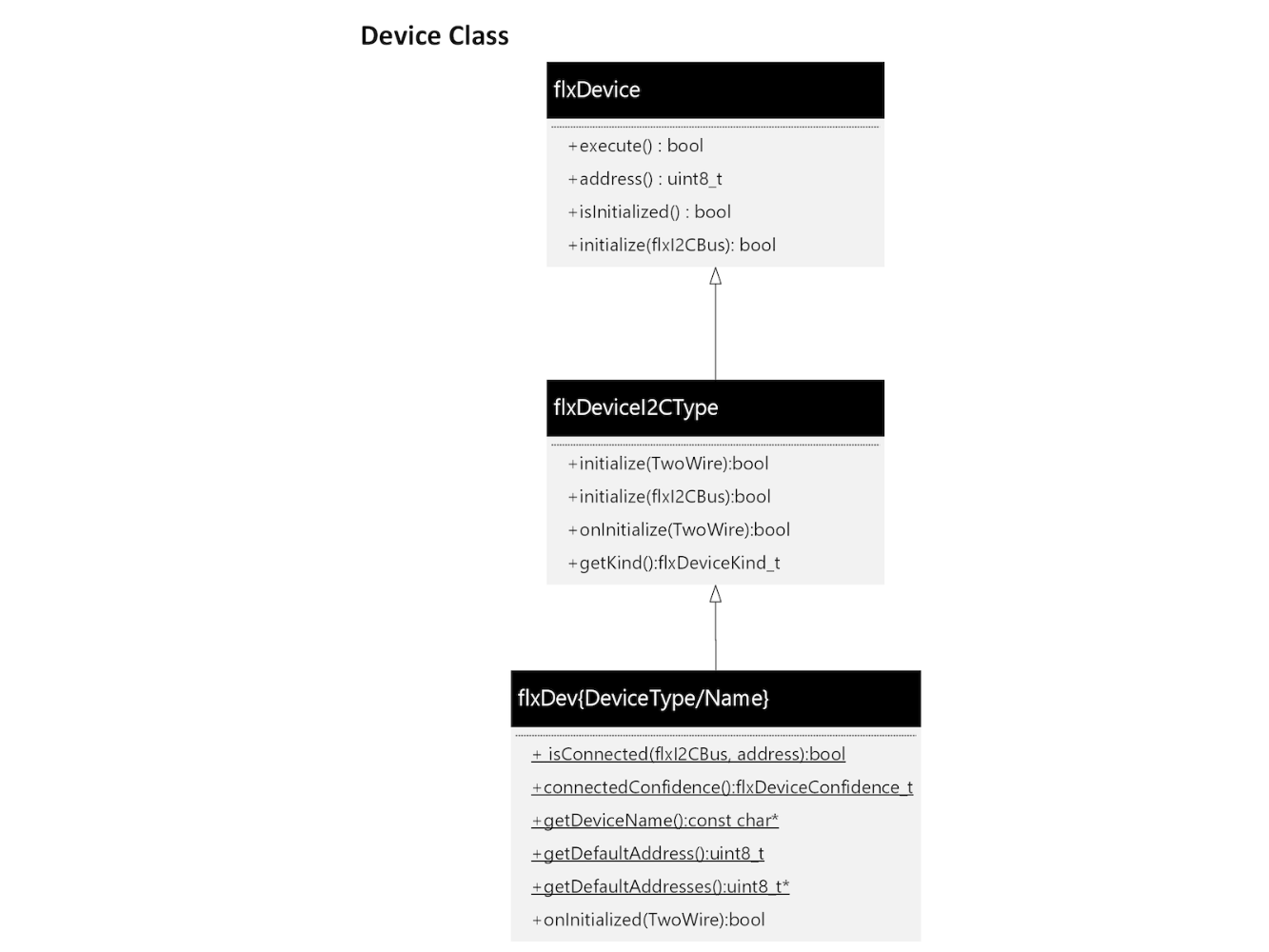
The following static methods form the device discovery interface:
isConnected() | Called with an I2C bus object - should return true of the device is connected |
connectedConfidence() | Returns a confidence level to indicate the accuracy of the isConnected() algorithm used. Helpful when resolving device address conflicts |
getDeviceName() | Returns the name of the device - should be a static constant |
getDefaultAddress() | Returns the default I2C address for the device. This method is deprecated |
getDefaultAddresses() | Returns a list of I2C addresses the device can use. The first address should be the default address for the device. This array is terminated with the value kSparkDeviceAddressNull |
For the startup sequence the following instance methods are important
onInitialize() | Called during the initialization process allowing the performance of the driver specific startup sequence. The Arduino TwoWire (Wire) object is passed in for use by the driver. Note: to get the address to use for the device, the driver calls the address() method. |
address() | Inherited - this method returns the address for the attached device |
isInitialized() | Returns true of the method onInitialized() returned true - indicating the driver is initialized. |
This class provides a common interface for the Factory class to use during the discovery and instantiation phase of device creation. The class is defined as a template, with the only template parameter being the class name of the Driver it represents.
The template definition for the DeviceBuilder class:
For the most part, all the methods in this class just wrap the introspection methods provided by the underlying Device class it represents. This allows allows the Factory class to work with object instances that bridge calls to the static methods of a Device object.
Example of a wrapped method in the DeviceBuilder template:
A goal of the Flux framework was to automatically register a device driver only by its implementation, not leveraging any external registration or implementation. The DeviceBuilder object is the key to meeting this goal.
In the implementation file of each device driver, a static global instance of the device drivers DeviceBuilder class is defined. Since all global objects are created during the system environment initialization, the DeviceBuilder can register itself with the Flux device Factory in its factory method. This is the trick to meeting the goal of device driver "auto registration".
The definition of the DeviceBuilder constructor:
The Flux Factory class flxDeviceFactory is a singleton, and globally accessible. The first call to get() will create the only instance of the object, enabling creation at startup.
To register a device driver, a static DeviceBuilder is added to the drivers implementation file.
But to make this easier, the following macro is defined.
Using this macro, device registration looks like the following (using the BME280 driver)
Easy, and similar to other use patters throughout the Flux framework.
The Flux Device Factory (flxDeviceFactory) is a singleton class that provides a single instance to manage device driver registration, device detection and device instantiation. Leveraging the common interface provided by the DeviceBuilder class, along with the static introspection methods each Device Driver implements, the Device Factory provides the key solution to meet the goals of the Flux framework driver auto load goals.
A key implementation element of the Device Factory is a list of available device drivers - registered devices. The registration list contains all the Device Builders in the system, sorted by the I2C addresses they support. For each address a device supports, an entry in the registration list, mapping address to the Device Builder class.
Additionally, if multiple devices support the same address, the corresponding entries in the registration list are sorted by identification confidence level. The devices with a high confidence level appear earlier in the registration list for the specific address, ensuring those devices are check for existence before deices with lower detection confidence level methodologies.
When the auto load operation takes place, the Device Factory traverses the device registration list. For each address, the high confidence devices are evaluated first. Any discovered device is instantiated, initialized and added to the systems active device list.
The Factory operation consists of two major areas: Device Registration and Device AutoLoad.
As outlined earlier, when the system initializes the application environment, it instantiates the static DeviceBuilder class, which inturn registers themselves with the Device Factory. This process is outlined in the following sequence diagram:

The diagram outlines the following Device Registration steps:
1) The system instantiates a Device Builder class, that represents a driver class of type <T> 2) In the constructor method of the Device Builder class, the Register Device method of the Device Factory is called, passing in itself as an argument. 3) The factory class retrieves the devices confidence level and list of supported i2c addresses 4) For each address the device supports, the following is performed
With all devices registering with the Factory at environment initialization, by the time Flux starts, all device drivers are registered and ready for the auto load operation.
The device auto load operation is initiated during application startup by the Flux framework by calling the buildDevices() method of the Device Factory. During this operation, the Device Factory traverses the sorted list of registered device, determines if a device is attached and if it is, creates the appropriate device driver. This process is outlined in the following sequence diagram:
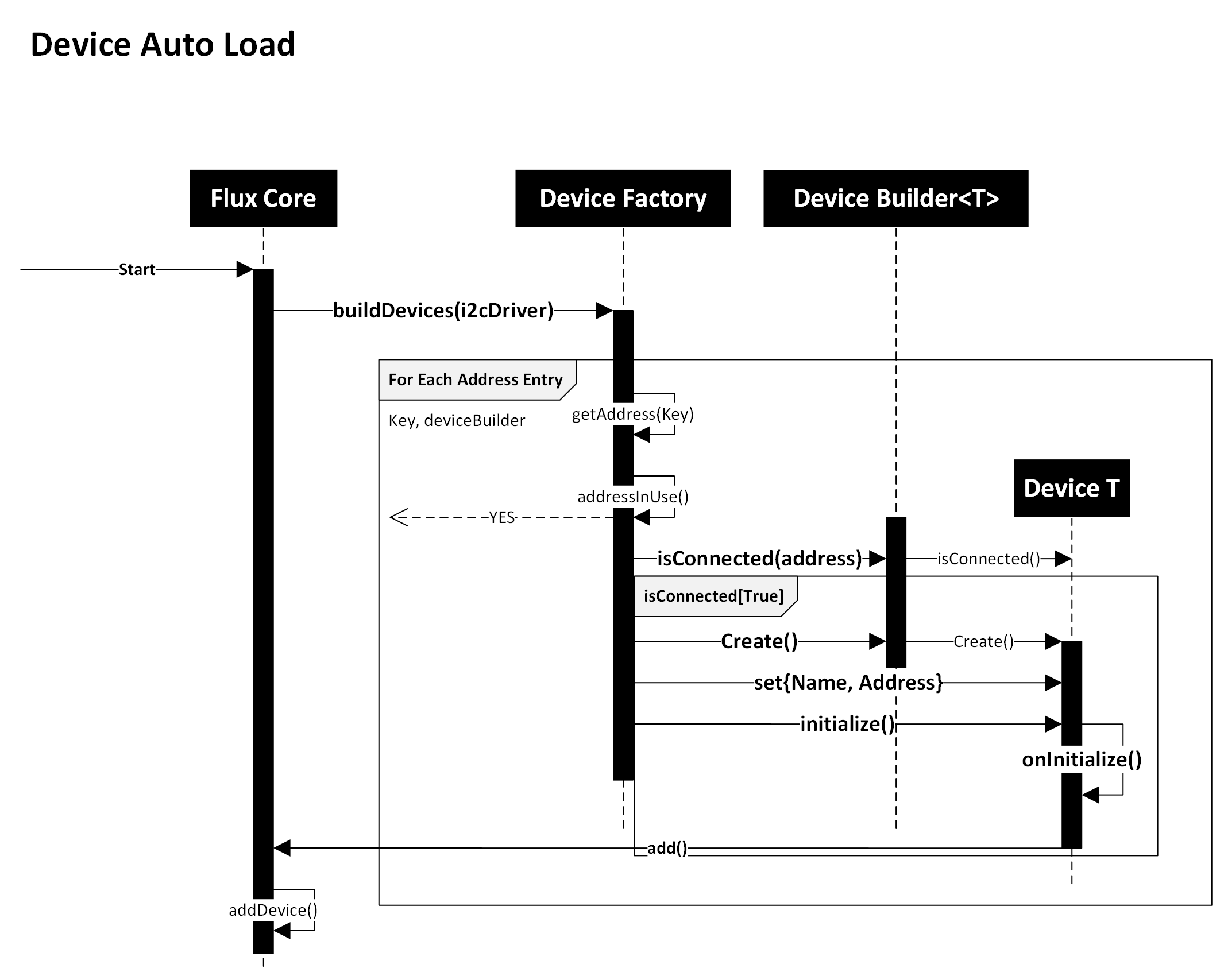
The diagram outlines the following steps for device auto load:
1) The Flux frameworks calls the buildDevices() method on the Device Factory 2) The Factory Class traverses its internal registered device list - which contains an entry for each address a device supports.
For each entry in the registered device list:
1) Retrieves the address being evaluated - this is derived for the key used to store the Device Builder in the list. 2) Verifies the address is not is use. This can occur when devices are manually added to the Flux system 3) Queries the device driver to determine if the device is connected to the system by calling isConnected() and providing the address to check 4) If the device is connected:
initialize() method, passing in the I2C driver. This sets up the internal Flux state of the driver.onInitialize() method of the driver, which performs device specific initialization of the driverIn summary, the I2C device auto load sequence of the Flux framework meets all goals for the subsystem by employing long-standing implementation patterns and leveraging the instantiation sequence of static/global objects.
The implementation meets the goals set forth for the subsystem:
With the background in place for system operation, a device driver is easily implemented following the details outlined in the document Writing a Device Driver
 1.9.5
1.9.5