|
SparkFun BMI330 Arduino Library
v1.0.0-2-gdbddb99
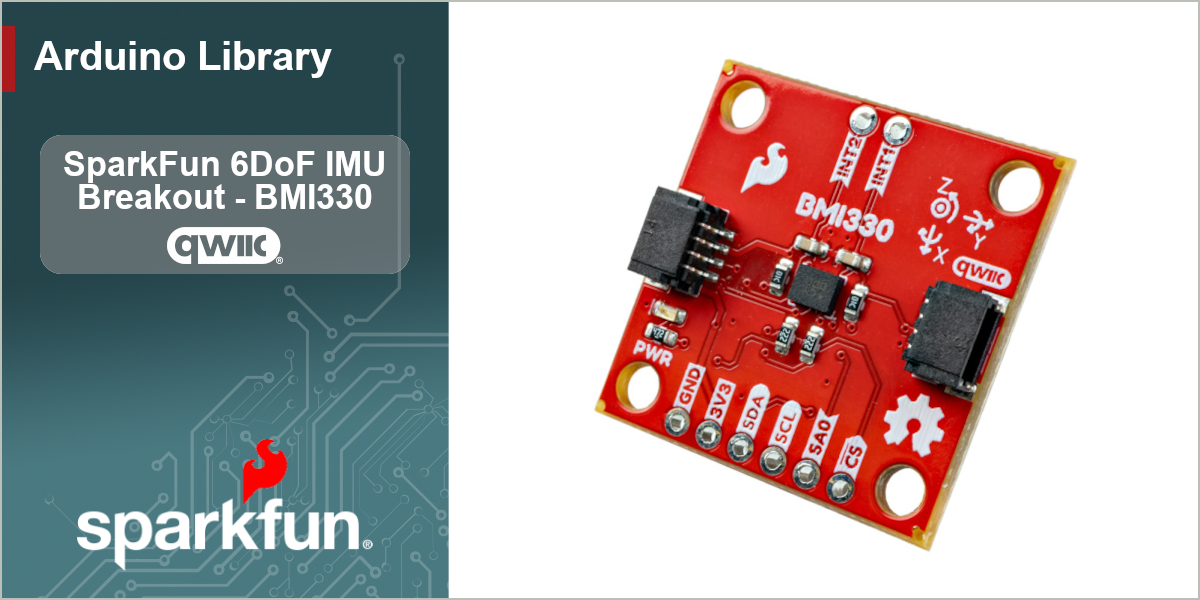
Arduino Library for the SparkFun Qwiic BMI330 6-DoF IMU (Bosch BMI330)
|
Arduino library for the SparkFun Qwiic BMI330 breakout, built around the Bosch BMI330 6-DoF IMU.





The BMI330 pairs a 16-bit triaxial accelerometer with a 16-bit triaxial gyroscope, a temperature sensor, a 2 kB FIFO, two interrupt pins, and an on-chip feature engine that detects motion events without the host doing any work. It is Bosch's extended-temperature successor to the BMI270, and it is considerably easier to live with: every feature lives in ROM, so there is no configuration blob to upload and no boot wait before the first sample.
This library allows you to:
Both sensors power up disabled. begin() leaves them that way, matching the device's own power-on state. A sketch that calls begin() and immediately reads gets zeros. This is deliberate: the right power mode is an application decision, and defaulting to high-performance would cost current on a battery design that wanted low-power mode.
No configuration file. The BMI270 will not report a single sample until the host uploads an 8 kB firmware blob and waits for it to boot. Every BMI330 feature lives in ROM. begin() is a chip ID check and a feature-engine enable, and this library carries no vendor binary.
The default I2C address is 0x68. Close the board's ADR jumper for 0x69. SfeBMI330ArdI2C::findDevice() will check both and confirm the chip ID, so a sketch does not have to know how the jumper is set.
Temperature is raw / 256 + 23, not raw / 512 + 23. The BMI323 uses 512. If you are porting a BMI323 driver, this is the line that silently reports half the true excursion from 23 °C. The library handles it in rawToCelsius().
Enabling a feature takes two writes. Setting a bit in FEATURE_IO0 does nothing until the host writes the commit register. enableFeature() does both. A hand-rolled driver that skips the commit reads the enable bits back correctly and the feature stays off - a quiet failure worth knowing about.
Plug a Qwiic cable in. That is the whole procedure.
| Breakout | Host |
|---|---|
| Qwiic | Qwiic |
| INT1 | any input pin (optional) |
| INT2 | any input pin (optional) |
The SPI pins are broken out as well, and the same driver handles them.
| Breakout | Host |
|---|---|
| SDI | COPI (MOSI) |
| SDO | CIPO (MISO) |
| SCK | SCK |
| CS | any output pin |
| 3V3 | 3V3 |
| GND | GND |
SPI is worth the extra wires in two situations. The first is throughput: at 6400 Hz with both sensors running, each sample is 16 bytes of payload, which is over 100 kB/s and eats most of a 400 kHz I2C bus. A 4 MHz SPI link moves it in a few percent of its capacity. The second is addressing - the board has one ADR jumper, so I2C tops out at two BMI330s per bus, where SPI needs only another chip select.
One BMI330 quirk the library handles for you: the device powers up undecided about its interface and commits to SPI on the first CS edge it sees, so the first transfer returns garbage by design. The library performs and discards that read inside begin() and after every softReset(). A hand-rolled driver without it usually fails to read the chip ID on the first try.
Both pins are brought out, and every source is routed independently:
Splitting sources across the two pins lets an ISR tell events apart without a bus transaction, which is the difference between a clean wake and a read that has to happen before the sketch knows whether it needed to.
Interrupt status registers are clear-on-read: one call to getInterruptStatus() consumes every pending flag for that pin. Read once and test the whole returned word against the sfe_bmi330_int_status_t masks.
The board fits no interrupt pull-up, so supply one externally if you configure the pins as open-drain.
| Example | What it covers |
|---|---|
| Example01_BasicReadingsI2C | Acceleration, rate and temperature over Qwiic |
| Example02_BasicReadingsSPI | The same sketch over SPI - compare the two |
| Example03_Configuration | Range, ODR, bandwidth and averaging, with measured noise at each; the ERR_REG configuration-error flag |
| Example04_DataReadyInterrupt | One read per sample, paced by INT1 |
| Example05_FIFOBuffer | Watermark interrupts and headerless frame decoding |
| Example06_WakeOnMotion | Any-motion wakes to full rate, no-motion drops to low power - the battery-design pattern |
| Example07_TapDetection | Single, double and triple tap |
| Example08_StepCounter | Step detector and step counter with a watermark |
| Example09_TiltOrientationFlat | Three posture features on one pin |
| Example10_SelfTest | Per-axis health check of both sensors |
| Example11_SelfCalibration | Measuring and correcting gyroscope offset |
| Example12_AxisRemap | Correcting a mounting orientation inside the device |
Significant motion (setSigMotionConfig(), BMI330_FEAT_SIG_MOTION) follows exactly the same configure / map / enable pattern as Example06 and has no example of its own.
extras/TapDiagnostic is a bench utility rather than an example: it dumps the feature-engine state, measures which axis your taps land on, and sweeps the tap detector across X, Y and Z.
| Accelerometer range | ±2 / ±4 / ±8 / ±16 g (16384 / 8192 / 4096 / 2048 LSB/g) |
| Gyroscope range | ±125 / ±250 / ±500 / ±1000 / ±2000 dps (262.144 … 16.384 LSB/dps) |
| Output data rate | 0.78 Hz to 6400 Hz |
| FIFO | 2048 bytes (1024 words) |
| Sensor time resolution | 39.0625 µs per LSB |
| Temperature | 256 LSB/K, zero at 23 °C, −41 °C to +87 °C |
| Supply | VDD 1.71–3.63 V, VDDIO 1.08–3.63 V |
| Current | ~15 µA suspend, ~45 µA low-power accelerometer, ~790 µA full IMU |
| Interfaces | I2C (0x68 / 0x69), SPI up to 10 MHz, I3C |
| Chip ID | 0x48 (the BMI323 reads 0x43) |
The feature-engine configuration structures carry the device's own units, because converting them would hide the quantization. The ones that matter:
| Field | Unit |
|---|---|
| Slope thresholds, hysteresis | 1.953 mg per LSB (1/512 g) |
| Durations, wait times, hold times | 20 ms per LSB (a 50 Hz internal tick) |
| Step counter watermark | 20 steps per LSB |
| FIFO watermark | 16-bit words, not bytes and not frames |
| Tilt minimum angle | 256 × cos(angle) - a larger number is a smaller angle |
frameLengthWords() converts a FIFO source set into words per frame, so a watermark can be expressed in frames without doing the arithmetic by hand.
Frames carry no tag saying what is in them. The order is fixed by hardware — accelerometer (3 words), gyroscope (3 words), temperature (1 word), sensor time (1 word) — with disabled sources simply absent. That is why readFifoData() takes the source set as an argument: pass the wrong one and the data decodes into plausible nonsense rather than failing.
readFifoData() reads only whole frames. A partial frame is left in the buffer and arrives complete on the next call.
tap.axis selects the single axis the detector runs on, and it ignores the other two. Z is the board's face, which is right for tapping the top of a board lying flat — but a board standing in a carrier, mounted on edge, or tapped through the side of an enclosure puts the impulse on X or Y, and a Z-axis detector will never see it however low the threshold goes. Bosch's own reference example uses Y.
If tap is not firing, check the axis before touching the threshold. The TapDiagnostic utility arms each axis in turn with a low threshold and counts what lands, and it polls rather than using the interrupt pin, so a wiring fault cannot be mistaken for a detector fault.
That polling point generalizes: a source mapped with mapInterrupt() appears in that pin's INT_STATUS register whether or not anything is wired to the pin. You can develop and debug any feature over a bare Qwiic cable and add the interrupt wire later purely for latency.
An ODR the selected power mode cannot support (6400 Hz in low-power mode, say) is not rejected by the register write. It sets acc_conf_err or gyr_conf_err in ERR_REG. Anything unexpected about a sensor's data rate is worth one call:
The device only accepts an axis-map update while the accelerometer is suspended. setAxisRemap() handles that — it saves the current power mode, disables the sensor, commits the map, waits for the feature engine to acknowledge, clears the interrupt flag the update leaves behind, and restores the mode. The cost is that sampling stops for a few tens of milliseconds, so this is a setup-time call, not something to do inside a data-ready handler. A remap also does not survive softReset().
Both routines reconfigure the accelerometer, take hundreds of milliseconds, and require the board to be still. The library saves and restores your configuration, but sampling in flight is interrupted regardless.
Self-calibration has one failure mode with no error flag: a run on a moving device reports success and leaves an offset worse than it started with, because the routine assumes any rate it sees is offset. Gyroscope offsets are also volatile — they are lost on reset or power-down, so either re-run the calibration at boot or read them out with getGyroOffset() and restore them yourself.
The library is in two layers. src/sfTk/sfDevBMI330.{h,cpp} is a comms-agnostic driver that knows the register map and nothing about Arduino; src/SparkFun_BMI330.h supplies the Arduino I2C and SPI wrappers. A sketch only ever needs the latter.
This product is open source!
This product is licensed using the MIT Open Source License
 1.9.5